Sunday, October 31, 2010

THE COWBOY - HERO OF THE AMERICAN WEST

By: Ashley Kath-Bilsky

Without question, there is a certain mystique to the American West -- one that has captured the imagination of men and women for generations. The imagery, language, and culture of the American West has influenced literature, paintings, sculptures, architecture, music, clothing, furniture, jewelry, toys, comic books, old radio shows, as well as television and motion pictures.

There is an instant visualization conjured just thinking about the American West. Images may be rooted in childhood, family history, personal experience, or from reading books about western romance or adventure. Just hearing words like pioneer, frontier, Indian, outlaw, gunslinger, stagecoach, saloon, covered wagon, cattle drive, or box canyon can cause one to picture the American West in a heartbeat.

Yet, no word can quite capture the American West as cowboy. More than a word or job description, cowboys have become the personification of a time and place that has mesmerized people all over the world from the 19th century to the present. For many, cowboy means the American West.

Perhaps no other medium has brought cowboys and the American West into our lives as successfully or vividly as television and motion pictures. It all began in 1903 with a 12-minute long silent film called The Great Train Robbery (now preserved and protected in the United States National Film Registry). Suddenly, what had only been imagined in the mind's eye took shape and form on film. Audiences immediately became enthralled. With the advent of sound, western films continued to gain popularity and resonate with audiences. Original screenplays, as well as a great many best-selling novels, were adapted to the screen. Matinee screen idols such as Tyrone Power, Errol Flynn, Gary Cooper, Henry Fonda, Randolph Scott, and James Stewart starred in westerns, which not only increased their fan base but helped make the 'western' a film genre all its own. But cowboy stars came from other walks of life as well. An unknown bit part player named Marion Morrison took a job in a film called The Big Trail to help pay college tuition. Realizing the young man had a great screen presence, his name was changed to John Wayne. In a career that spanned five decades, John Wayne became the most popular western movie star in the world.

With television came westerns, a favorite for the entire family. Films previously only available for viewing at a theatre were now televised into your living room. Popular movie cowboys became stars of their own television show. In 1959, there were 26 western shows on television.


In the 1960s, half-hour programs extended to hour long shows, many of which were now filmed in color. In the decades that followed, innovative westerns offered everything from contemporary set crime dramas like McCloud and the wholesome family drama of Little House of the Prairie to award-winning mini-series formats such as Lonesome Dove and cable shows like Deadwood.

The cowboy has become an icon, the physical embodiment of the American West and (more often than not) the hero who ultimately saved the day before riding off into the sunset. He might be driving a herd of cattle, leading a wagon train of settlers to a new frontier, or the strong patriarch of a ranching family. Perhaps he was a loving single father with a mysterious past and knack for using a rifle at lightning speed. He could be wearing a white hat and badge, risking his life on dusty streets to keep a town safe. Or, he might be more complex and tormented. One of my personal favorite film cowboys was Ethan Edwards, a Civil War veteran searching for a niece captured by Comanche Indians. Driven by hatred and prejudice for his enemy, Ethan's arduous quest to save his niece becomes a determined, fatalistic mission to put an end to the misery and humiliation she has suffered once and for all. If you haven't seen John Ford's 1956 classic motion picture, The Searchers starring John Wayne and Jeffrey Hunter -- do so immediately.


Ultimately, I think it is the complexities of the cowboy character that has made him remain a constant favorite with audiences. He isn't perfect and maybe that is what we find so endearing. He may be reluctant, have a dark past that taught him some pretty tough life lessons or caused him to follow a trail that ended badly. But at his core, his heart, his mind and his soul -- he is a good man who will save the day, even if he dies trying. It is the inherent goodness in his spirit, along with the human flaws, strengths and weaknesses, that brands the cowboy in our heart and mind as a hero of the American West.

For many of us, there remains a soft spot in our heart or a sentimental smile on our lips remembering a favorite western film or televsion show. A writer's fond affection for the cowboy hero of their youth may often influence the appearance or qualities of a hero they create. A reader may visualize a certain actor when reading about a hero in a book. I know I do, usually with recurring favorites like Gary Cooper, John Wayne, Tom Selleck, or Lee Majors. And so, I think it's time we all take a moment to reflect and remember the cowboys who first captured our attention on television and film. For many of us, they will never grow old or die, and continue to inspire future generations. I've made a short video tribute to the actors who brought many cowboy heroes to life on film. I hope you like it. And if you have a favorite western film or cowboy hero, please share the memory with us.

Thursday, October 28, 2010

What Started My Love For Cowboys and Ranchers?

r
My Early Hero
Second Only 
To My Dad

Welcome to Sweethearts of the West. We hope you'll visit us often.

My name is Caroline Clemmons and I write contemporary, historical, and time travel romances set in Texas. During my early years, I was one of the thousands of young girls in love with Roy Rogers—that’s before I realized that Dale Evans had already stolen my singing cowboy. Later, my family drove through ranch land on trips from Lubbock, Texas to visit my grandmother in southwestern Oklahoma. Even when we happened by a roundup near the road one day, my dad didn’t stop to let me watch. He was a very nice man, but strictly a Point A to Point B traveler with no detours. I drove the poor man nuts chattering on and on about cowboys anyway.

My up close and personal introduction to ranching was at the Hicks family’s Mayan Ranch located on the Medina River near Bandera, Texas. This is a first class guest ranch, and my daughters and I fell in love with the ranch and the area. My husband, not so much, but he’s a good sport and let us have our fun. And the Mayan is a great place to have that fun, true western style. The Hicks are a large family, and the Mayan is an efficient, family-run enterprise. Bandera bills itself as "The Cowboy Capital of the World." I’m willing to believe the claim. In addition to genuine working ranches, there are numerous guest ranches in the area. (Doesn’t "guest" sound better than "dude" ranch?)


Mayan trail ride
  The Mayan Ranch caters to everyone from returning cowpokes to city slickers. Did we ever fall into the latter group! On arrival we were shown to our lodgings—a two-bedroom cedar board-and-batten cabin nestled among the trees and furnished in picturesque western style. As Texans say, "We were in high cotton." The Hicks family provides first class everything. Meals are all you can eat in the dining room, a cookout on the patio, or a hayride to breakfast by the river.

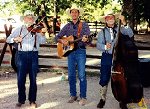
Small Band at the Mayan
Entertainment includes parties each night, swimming, dances complete with instructors, daily trail rides, cowboy singers and musicians, and a trip to their Old West town, Hicksville. I was hooked on ranching life! Of course, ranching is so much easier with the Hicks family and their employees taking care of all the work!

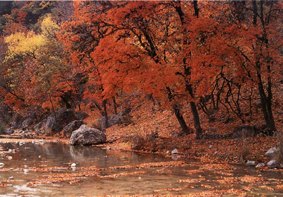
Lost Maples State Park--my photo


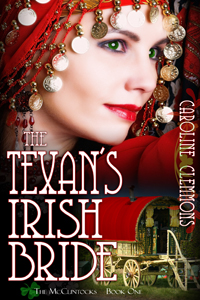
Is it any wonder that so many of my western stories take place in this setting? Nearby is the picturesque Lost Maples State Natural Area with the only native maple trees in the state. Inhabited by prehistoric peoples, the area was a hot spot for Comanche and Apache Indian renegades as well as both Indian and anglo  rustlers. I took advantage of that setting for the rustlers in my latest release, THE TEXAN'S IRISH BRIDE.

Lost Maples in the fall
Bandera is within easy driving distance from the unique city of San Antonio. On a trip to attend a San Antonio RWA chapter conference one year, my youngest daughter and I took a side trip through Bandera and Lost Maples to refresh my memory for THE TEXAN’S IRISH BRIDE, available from The Wild Rose Press. From Bandera, we wound around through Medina—stopping for apple cider, Fredericksburg, and Kerrville on our way home. Not a direct route, it’s true, but very scenic. This would be a wonderful area in which to live, but land prices are rising by the minute.

Bandera Texas--Cowboy Capital of the World!
What better place to locate the ranch owned by my book’s hero, Dallas McClintock, than on the Medina River near Bandera? Dallas raises cattle, sheep (yes, they can coexist on one ranch), and breeds and trains horses. It’s his horse breeding that creates the story, for Dallas has been to deliver horses to a buyer and is on his way home when the story opens. He hears screams from the heroine, Cenora Rose O’Neill, and rushes to her rescue, killing her two attackers while receiving gunshot wounds. Instead of a reward for saving his daughter, Sean O’Neill traps Dallas into marrying the lovely Cenora. Not a great hardship except that Dallas is not ready to marry anyone, much less a girl he doesn’t know. Even worse, he inherits the other four members of Cenora’s unruly family and their numerous problems, as well as the new crises they create or him. And that makes for lots of turmoil.

Here are a couple of reviews:

"There were no down times in this book. The action was almost non-stop." 5 Hearts from The Romance Studio

"What starts as a clash in cultures becomes a fantastic story…Just when you thought a happily ever after was just around the corner, another corner appears." Top Pick from Night Owl Reviews


THE TEXAN’S IRISH BRIDE is available in print or download at www.thewildrosepress.com/caroline-clemmons-m-638.html, as well as at Amazon, DigiBooks, and other online sources.

We authors at Sweethearts of the West love our readers! Follow us on our sidebar, please. Y'all come back now, ya hear?

Monday, October 25, 2010

A CHALLENGING JOURNEY


Being asked to be a part of this blog is so exciting, but I have to say I feel intimated by everyone having so much knowledge of western and Texas history. I don’t have a particular western story to tell about a particular place, so I’ll just tell a little bit of general information about myself and my endeavors of late.

First, I’m a native Texan. Fifth generation. My ancestors migrated to Texas from Alabama and Mississippi during and after the Civil War. Before that, they came from Ireland mostly, landed in the Carolinas and migrated south. So my genes have been here a long time.

I grew up among cowboys. I traveled away from that culture for a time, but I now live smack-dab in the middle of cowboy country. South of me is a town and county where more than a few rodeo cowboys own retire and/or own ranches. North of me is cutting horse country where on any given day you can drive up the highway and see magnificent equine athletes grazing on both sides of the road. Fort Worth is the home of the American Cutting Horse Association and some of the premiere cutting horse shows in the country occur there. Watching a well-trained cutting horse strut his stuff is an entertaining sight.

I set out to write about fifteen years ago. Back then, I belonged to no organizations, had never heard of RWA and had no clue how New York publishing works. If I had known how difficult selling a book in NY City is, I might have found it too daunting to tackle. It took six years for me to sell. During that time, I joined various writing organizations and critique groups, including a “destructive critique” group that almost made me give up writing altogether. But it was an educational experience I’ll never forget. It toughened my hide for what was eventually to come in the publishing biz. There’s a reason for everything, as my departed granny would tell me.

My first book, “THE LOVE OF A COWBOY,” was a book about a cowboy only by coincidence. It started out to be a Harlequin book. I attended a writers’ meeting one day in which a Harlequin author outlined the hooks that might be attractive to a Harlequin editor, i.e., cowboys, alpha males, families, secret babies, lost love recaptured. On my way home from the meeting, I thought about it and decided I could write about those things. In fact, I could write about ALL of those things.

The next thing I knew, I had a 165,000-word saga about an Idaho ranching family and how a half-Filipino Texas woman changed their outlooks on life. It won a first place in the Southern Writers’ Conference contest and the editor who judged it bought it. She had no interest in the saga, but wanted to pluck out the romance between the two main protagonists and publish it as a romance. After banging on those NY City doors for six years, no way was I going to say “no.”

A part of me still thinks the family saga was a better story and I often wonder how my writing life might have been different if she had bought the saga. But among the many things I didn’t know back then was that unless you’re writing science fiction or fantasy, or non-fiction, the chance of an unknown name selling a 165,0000-page book in New York is as scarce as hen’s teeth.

I’ve now written and published eight mainstream romance novels and co-written seven zany romantic comedies. My most recent romance novel, “MAN OF THE WEST,” was released in April, 2010. It’s a sequel to “LONE STAR WOMAN,” released last year. Both books are set in the Texas Panhandle in ranching country and are stories of cowboys and cowgirls and ranching families.

The latest Dixie Cash book, “OUR RED HOT ROMANCE IS LEAVING ME BLUE,” was released by Avon in June. The next Dixie Cash book, “I CAN’T MAKE YOU LOVE ME, BUT I CAN MAKE YOU LEAVE,” will be released next summer. The Dixie Cash books are a series revolving around Debbie Sue Overstreet and Edwina Perkins-Martin whose hijinks keep people laughing.

I’ve learned a lot about the publishing business and I’m not nearly as intimidated by it as I used to be. It’s sort of like wrestling a dinosaur. For example, my contemporary western trilogy proposal that has been on the table in New York for more than a year has been rejected by all but one of the big guys. It’s sort of a Dallas (TV show) knock-off, but more cowboy-ish than Dallas was. The climate in NY publishing right now is frosty. So I’m working on another proposal, which I hope to have ready for submission in the next couple of weeks.

I’m also working at putting a couple of my out-of-print Anna Jeffrey books up as Kindle books. So far I’ve uploaded “SWEET WATER,” which was released in paperback in 2006. It won some contests and has some good reader reviews online. It’s available in the Kindle Book Store on Amazon as well as B&N, Sony, iPad and Kobo for $2.99. It isn’t a cowboy story, but it’s set in far West Texas, and has plenty of Texas flavor. A blurb is up on the Amazon page.

At the same time I’m doing all of that, I’m striving to get my rights back on other books that have gone out of print.

Writing fiction is an inspiring, interesting enterprise, sometimes rewarding, oftentimes disappointing. But I still do it every single day. I’m determined.  


Friday, October 22, 2010

Oh, Those Cowboy Hats!


In 1865, with $100 John B. Stetson rented a small room, purchased a few tools and ten dollars worth of fur –and the John B. Stetson Hat Company was born.  One year later the “boss of the plains” or hat of the west was born. 

Back in Mr. Stetson’s day, most everyone knew and practiced better manners than what we do today. But since hats fell out of fashion many years back, entire generations have come of age with no clue whatsoever as to the proper “hat protocol.” 

In Wild Texas Wind, my June 2010 historical release from The Wild Rose Press, my hero, Raz Colt seldom removes or tips his hat.  This is deliberate; he makes it clear from page one he’s no ordinary gentleman—in fact, he’s no gentleman at all.  So he doesn’t bother with the usual formalities.  Much to the irritation of heroine Arden O’Hara.   

But as I work on the sequel to that story, inspired by the character of Confidence Man and gambler—and Raz’s side kick in Wild Texas Wind—Kip Cooper, I find myself paying closer attention to a gentleman’s manners—specifically those “hat manners” mentioned above.  Kip is a man who likes to charm, likes to blend in and doesn’t shun societal customs.  (In other words, he’s the complete opposite of Raz!) But since there are few things as romantic –or flirtatious!—as a gentleman sweeping his hat from his head in the presence of a lady, I wanted to know more.

According to the John B. Stetson Hat Company there are very specific rules to dictate when a gentleman should tip his hat, and when he should remove it. 

Tip your hat:
If a woman thanks you
After receiving directions from a stranger
If you excuse yourself to a woman
When walking with a companion and he greets a woman not of your acquaintance

Remove your hat:
During the playing on the National anthem
Upon entering a building
During an introduction
When attention a funeral
When initiating a conversation

An excerpt from Wild Texas Wind is below. 

All Raz Colt wants is land, a quiet peaceable existence and to put his life as a hired gun in the past. When the chance to earn a sizable fortune by rescuing a kidnapped heiress comes his way, he seizes the opportunity. Trouble is, the heiress doesn’t want to be rescued. Offsetting Arden O’Hara’s beauty is a rattlesnake personality and shrewish temper. Despite her claim that she faked the kidnapping so her fiancé would ride to her rescue, Raz knows someone is out to kill her. And if anyone gets the pleasure of wringing her lovely neck, it’s going to be him.

Arden O’Hara is desperate to go home. Her fiancé was supposed to ride to her rescue, proving it’s her–and not her father’s money– he loves. Instead an arrogant stranger, with weapons strapped gun-fighter low and a decided lack of sympathy for her situation, shows up spouting a ridiculous tale about someone trying to kill her. It’s infuriating when Raz Colt’s claims prove true after not one but several attempts are made on her life. She has no idea who this fast gun with the deadly aim is, or why he makes her feel as wild and untamed as the Texas wind. But like it or not, if anyone is capable of getting her home alive, it’s Raz Colt.

~~
Arden couldn’t be certain the exact moment she realized the approaching rider was watching her. But the chill crawling up her spine was the doing of the man lying unconscious beneath her. He’d deliberately tried to frighten her.
And for the moment, she was stuck. Her chin hovered mere inches from his chest. No matter how she struggled she couldn’t free her hair from beneath his dead weight.
“Wake up.” She tried to squirm free, to kick him—anything. She reached awkwardly around to slap at his cheek, but to no avail. He didn’t stir. Only the steady rise and fall of his chest assured her she hadn’t killed him.
The rider moved closer, slowing his pace to take in the scene before him. It was too late to play dead. She had a funny feeling it wouldn’t have done much good anyway.
The metal of the .44 grew warm against her palm, but her hand, pinned awkwardly between her body and the man she lie upon, was numb and tingly from lack of circulation. The rider stopped a few feet away and dismounted. He walked closer, then stopped, studying her with a smug expression. When the corners of his mouth turned up, she had the oddest feeling he considered himself the cat to her mouse. Every instinct screamed the truth. This was the killer.
In one grand attempt to remain alive, she rolled to one side, ignoring the sting of her scalp, and freed her arm. Cocking the hammer with her thumb, she trained the gun on him. “Don’t come any cl—”
A hand on the back of her neck slammed her face down on the ground. Her finger was squeezed tight against the trigger as he—the arrogant ass she’d been unable to rouse a moment ago—closed his hand over hers. Three shots rang out almost simultaneously, the kick from the gun lurching her arm as it fired. Something warm buzzed past her ear, like the hum of a bumble bee but much too fast and much too hot. She opened her mouth to scream but inhaled a mouthful of dust and dirt instead.
Silence reigned for only a second before he rolled off her, one hand pressed to his head where she’d struck him. “Son of a bitch.”
Sputtering, Arden sat up and wiped an arm across her mouth. The rider lay slumped at an odd angle in the dirt. She turned to the suddenly-conscious stranger “You killed him.”
He stood, hand still on his head. “You’re welcome.” With a motion of his finger, he wordlessly told her to stay put. Gun in hand, he approached the dead man, then nudged him with the toe of his boot. He bent to press two fingers to the side of the man’s neck. “He’s dead.”
“So I gathered.” She noted the precision of the two holes, one square in the chest, the other right between the eyes. Either would have been a lethal shot. Another chill slithered down her spine despite the sun’s merciless heat. Who was this man with such deadly aim?
“Do you know him?”
The sight of the corpse, already taking on a chalky hue, began to sour her empty stomach. She drew her knees up to her chin, shaking her head in answer to his question. “Do you?”
He glanced down at the man’s face, cocked his head as if considering. “By reputation only. At least I think it’s him.” He rose, reloaded, and holstered the .44. with a smooth motion that told her he did it often and without thought.
“Why did you kill him?”
“What?”
“Why didn’t you just shoot him in the hand or the leg or something?”
“Are you out of your goddamned mind?”
“Anyone who can shoot as accurately as you could have disarmed him without killing him.”
“Hell, yeah. I could have invited him to tea, too.” He stepped a few feet away to retrieve the other man’s revolver from where it had landed. “But I have a bad habit, sweetheart. It’s called breathing. And I’m kinda partial to doing it.”
As he approached her, she reached for the extra gun he carried. “I’ll take that.”
“The hell you will.”
“I feel the need to protect myself.”
“And you’re doing a half-assed job of it, from the looks of things.” He knelt down in front of her. “Are you all right?”
She had to admit, his concern was somewhat touching. The memory of him throwing himself over her, shielding her with his body, caused a warm flush of gratitude. “I’m fine. Thank you.”
“Good. I got ten grand riding on your well being.” He glanced back at the other man. “Who wants you dead, Miss O’Hara?”
“No one.”
Raz shifted his gaze back toward her. Something in her voice wasn’t quite right. “You sure about that?”
“Who would want to kill me?”
“Anyone who has known you more than five minutes.”
Hurt flashed in those big green eyes before she pushed to her feet. “I’m leaving.”
“That’s a good idea,” he agreed. “Whoever wants to kill you will try again when he doesn’t come back.”
“I assure you, no one wants me dead.”
“That remains to be seen.” He left her to rummage through the dead man’s pockets, looking for anything that might identify him. But he didn’t need a name to know what Arden O’Hara would have suffered before he killed her. Finding nothing of use, he hoisted the body over his shoulder and draped it across the back of the extra horse.
“We’d better head to the nearest town and find the sheriff.” He didn’t bother to add there would probably be a reward.
“We?”
“Yes, we.” he repeated. “Don’t you want to know the identity of the one person in the whole world who wanted to kill you?”
She stared at the corpse as if it would bite her. “I told you, I don’t know him.”
“Whoever hired him knows you.”
She briskly rubbed her arms as though to ward off a chill. “Look, Mister—”
“Colt. Raz Colt.”
“Fine. Colt,” she repeated. “I think a terrible mistake has been made here. I’m quite certain this man never meant to harm me. I think he was probably trying to scare me.”
“Men like this don’t play games, darlin’. They kill.”
“You speak as though you have personal experience.”
He shrugged. “I don’t make apologies for what I am.”
“What are you?”
“A law-abiding citizen.”
She raised a brow in his direction before dropping her gaze pointedly to his guns. He wasn’t about to explain his lifestyle to her. He was a hired gun; it wasn’t something he was proud of but it was what he knew, what he was good at. And he liked to think he provided a service to the local law enforcement. Any low-life he took off the streets was one less gun the sheriff would have to face down.
Still, her decided lack of fear in all of this nagged at him. Sure she was a little green around the gills from staring at the dead guy, but not once had she come close to panicking; not before he’d entered the little shack, not when he approached her and not now, when she’d damn near met her maker.
He removed tobacco and paper from his shirt pocket and calmly rolled a cigarillo. “Mind telling me why you’re ‘quite certain’ this man wouldn’t harm you?”
She sighed dramatically. “It’s a long story.”
“I’ve got time before he starts to rot.”
“I’m sorry you were dragged into this, but I was not kidnapped, at least not really.” She began to pace, moving away from him.
The cigarillo complete, he scraped a match on the heel of his boot. “I’m listening.”
She walked toward a nearby rock and took a seat, resting her elbows on her knees, chin in her palms. Another sigh. “I wanted Geoffrey to rescue me.”
He inhaled, held the smoke in his lungs, and willed himself to stay calm. A million different responses came to mind, most of them more colorful than what she’d spouted earlier. At last he allowed a stream of smoke to slowly leave his nostrils. “Why?”
She sprang to her feet and resumed pacing. “I needed to know if he cared about me or if it was the money. I didn’t want Daddy involved, I knew he’d worry.”
“That doesn’t explain our friend over there attracting flies.”
“The men I hired would never have sent a man like that, not even to scare me.”
“The men you hired?”
“Yes. I think we need to assume this man was after you rather than me. A man like you most certainly has enemies.”
“Not alive.” He threw the cigarillo aside and stalked toward her, thoughts of killing her himself running wild. “Are you saying I damn near took a bullet for someone who staged her own kidnapping?”
She shrugged, almost childlike. “I’m sorry.”
“You’re sorry?”
“Yes. I’m sure Daddy will still pay—”
You’re sorry?”
“Mister Colt, you’re doing that repeating thing again.”
For the second time that morning, Raz hoisted her over his shoulder, this time taking care to remove his guns. He pressed one against her ribs, partly for effect, partly from anger. “Not half as sorry as you’re gonna be.”




Tuesday, October 19, 2010

Rangers, Legends and Myths

"Brave too much," said an American Indian who rode with Texas Ranger John Coffee "Jack" Hays in early 1800s Texas.

I can envision Gerard Butler playing the role of Hays. What do you think?

The Indian quoted above who rode with John C. Hays may have been Lipan Apache Chief, Cuelgas de Castro. A small group of Lipan Apache are secondary characters in my story, "Are You Going to the Dance?" in the Civil War anthology Northern Roses and Southern Belles.

I write western historical romance for which I'm always taking inspiration from my Texas family's history. My great great grandmother came to Texas with farmers from Alsace Lorraine, France, and settled in the early 1840s near San Antonio in a place they named Castroville. The settlers were accompanied to that area by John C. Hays and five of his Rangers. My great great grandmother learned to speak the Lipan Apache language and traded with a small group that lived close by their homestead. I can imagine that on the journey from San Antonio she began learning their language from the Lipan Chief, who only rode with Ranger Hays.

According to an article by Mike Cox for the Texas Ranger Hall of Fame, Hays helped to build one of the Ranger traditions ... toughness mixed with a reliance on the latest technology. In the case of the Rangers that technology would be the Colt revolver.

"They were men who could not be stampeded," said Col. Homer Garrison, Jr.

The myth of the Texas Ranger lends itself to intriguing other-worldly beings. One of my novellas, under my pseudonym, Jenette DuPris, features a hero who is a Texas Ranger and a werewolf.

It has been said that a Texas Ranger could "ride like a Mexican, trail like an Indian, shoot like a Tennessean, and fight like the devil." During the war with Mexico, in 1846, the Rangers were labeled "Los diablos Tejanos," the Texas Devils.

It was normal for every Ranger to carry more than one pistol, or revolver, rifle, and knife, one of which was usually a Bowie knife. In the time of the Civil War, frontier protection was provided in Texas by the Rangers, whose pistols or rifles proved to be the "legal authority."

In 1874, the Texas legislature created the Frontier Battalion, led by Major John B. Jones, and an organization called Special Forces, under Capt. Leander McNelly. Many of the Ranger legends grew from this lawless time in the Old West.

I've enjoyed stories about Rangers and their myths. They always inspire my imagination and make for some great hours of reading as well as writing, both nonfiction and fiction. What do you think? Do you have a favorite story, true or mythical, about a Ranger?

Jeanmarie Hamilton, Romancing the West

http://www.JeanmarieHamilton.com

Out now:
Northern Roses and Southern Belles
Pure Heaven
Moonlight Desperado
Seduction

Sources: Handbook of Texas On-Line; Texas Ranger Hall of Fame

Monday, October 18, 2010

New Experience in the Ambiance of the Past


I recently attended an eight course Italian dinner with a different wine served with each course in an ice house built in the late 1890's. The room was about 12' x 16' with walls of two feet thick rock. Huge beams over low doorways gave the feel of a building to be reckoned with.

Sitting in the room for three hours through this meal, feeling the confines of the room, the solidness of the walls, and the squeak of the floorboards, I could see this building being used to keep a cattle thief or bank robber on hold until the circuit judge came to town. Or a drunk thrown in the building overnight to sober up.

The town of Diamond, Oregon at its peak had fifty residents. It was a hub in the area for cattle ranches and shepherds to get supplies and catch up on the news. To this day they have five residents and the Diamond Hotel where we had the eight course meal.

The history in this thinly populated area of Oregon is ripe for many stories. And as usual they are spinning in my head. One of the tales is how a certain meadow was the favorite summer vacation spot for prostitutes. They would set up shop in the meadow for the sheepherders and cowboys in the area because they were too busy to get to town. I'm using this scenario for a short story I'm working on.

When you learn or see a part of history does it start your minding wandering? Have you visited somewhere and started wondering about he people who once lived there?

*The stone room off to the side of the top photo is the ice house.

Paty Jager
www.patyjager.net
www.patyjager.blogpsot.com

Sunday, October 17, 2010

What Are The Odds?

Hi y’all. Like the other Sweetheart writers you’ve met, I’m thrilled to be a member of this extraordinary group. I write contemporary romantic suspense set in some of the western states where I’ve lived. If you’ve visited my website www.sandracrowley.com or my blog www.driven2danger.blogspot.com , you know my husband, kids and grandkids are 5+ generation Texans and understand why Texas has received the lion’s share of settings in the books I’ve written so far. However, that doesn’t lessen my love for my current home--Colorado’s mountains. Their peace and beauty feed my soul and creativity. So, you can see why deciding what to post first was a struggle until a chance meeting at a fall celebration neatly entwined Colorado and Texas as they are in my life.
Grand Mesa lies between the Colorado
and Gunnison Rivers east of Grand
Junction, Colorado.
Colorado promotes Grand Mesa as the world’s largest flat top mountain. However, it isn’t flat like a table. Its uneven surface resembles the bumps and dips of a giant cinnamon roll. Every year as nighttime temperatures drop at higher elevations, the aspens’ fall leaf color flows downward as if the yellow already prevalent on top were melted butter spilling over Grand Mesa’s edges. Gullies brighten first to create fingers of yellow and gold, and then the earthbound sunshine spreads across the slopes and onto ridges. Each dawn reveals fresh progress that highlights the sunrise with the promise of another glorious day. 

Raber Cow Camp, built in the 1930's, is now an Historic Site.

These are the days when local ranchers transport their cattle herds to lower fields, leaving behind rich mountain meadows via the trails, OHV roads, and CO HWY 65 unavailable to the cattle operations of the  1930s and 40s when stock was driven down the west side of the mesa at Kannah Creek and over to a valley railroad connection.

Highway 65 provides a smooth, curving drive up from the valley floor for thousands of visitors on Color Sunday--Grand Mesa’s fall foliage celebration. Hosted the 4th Sunday in September every year, this event is the major fund raising opportunity for communities and attractions situated along the road. Mesa, a small town on the north side of Grand Mesa, has continuously sponsored a dinner since the 1940’s when the women of the Methodist Church cooked the food in their homes. Now, the 4-H heads the fundraiser with the help of Job Corp and local residents. This year, they served the largest number of attendees for a total of 810 meals. My husband and I stopped at Mesa’s community center and filled our plates with turkey and all the trimmings. We had no sooner stuffed our mouths with bites of tender, juicy white meat than an elderly couple sat beside us. A few pleasantries later, the gentleman mentioned they retired in Cedaredge, on the south side of the mesa, after having lived in Bartonville, Texas. Back in 1970, my first boyfriend lived in Bartonville; I lived in Argyle. The towns were situated about 7 miles apart and were the size Mesa is now. 
Available January

What are the odds that after almost 40 years and dozens of homes in numerous places, my husband and I take a day trip and meet a lovely couple at a turkey dinner who were from my first boyfriend’s hometown in Texas, over 1000 miles away? The only thing more bizarre would have been running into him, or getting caught up in a situation like the characters in my romantic suspense novel which will be released in January. In CAUGHT BY A CLOWN, a spontaneous freelance journalist on a mission of mercy finds herself entangled with a methodical undercover agent out to settle a score.
I hope you’ll stop into Sweethearts of the West often--you’ll find us and our books fun, exciting, sweet, passionate, informative and, maybe, addictive.

Saturday, October 16, 2010

Cowboy Slang

If you write either contemporary or historical Western romances then you know how difficult it is to create authentic cowboys who "talk the walk."

I write contemporary cowboy stories so my heroes are fairly educated, but I love to throw in a few quirky characters—usually geezers—who are throwbacks to the "olden days." In order to make those characters realistic to my readers I turn to two of my favorite books: Cowboy Slang and Cowboys Talk Right Purdy by Edgar "Frosty" Potter.

One reason I have my secondary characters use colorful language is that their phrases conjur up word pictures, which add humor to my writing—most of my readers expect a little "cowboy" humor in my books. Here are a few examples of phrases from "Frosty's" book that trigger word pictures in the reader's mind.

"A man that straddles a fence usually has a sore crotch."


"His hoss throwed him forked-end up."


"She didn't wear 'nough clothes to dust a fiddle."


Below are some of my favorite Cowboy Sayings:
Blind: So blind he couldn't see through a bobwire fence.
Big: As broad beamed and cow-hocked as a Holstein's behind.
Braggart: He was full of wind as a bull in corn time.
Bronc Rider: I got throwed so high I could've said my prayers before I lit.
Courting: Thet little feller with a bow an' arrer can shore bugger up a cowboy.
Dead: He'd saddled a cloud an' rode to the great beyond.
Drunk: He drank so much hair oil he had to eat moth-balls to keep down the fur.
Dumb: He couldn't hit a bull's ass with a banjo.
Fighting: I squirted 'nough lead into him to make it a payin' job to melt him down.
Religion: Most of his religion was in his wife's name.
Swearing: He could make a bull-whacker's cussin' sound like a Methodist sermon.

Do you have a memorable line one of your characters has said...or have you read a book with a character whose language and words made him or memorable?

Marin
Roughneck Cowboy
(Feb 2011)
Rodeo Daddy (April 20110)
www.marinthomas.com

Tuesday, October 12, 2010

Gold Bug Mine, Placerville, California

I am so lucky to live in the beautiful Sierra Mountains of California near Lake Tahoe. This area, so full of living history, is a gold mine for writing my stories. A couple of weeks ago my daughter and I finally took the time to visit the Gold Bug Mine which is located a few short miles from our home. Since the heroine in my current wip inherited a gold mine, we thought now was the perfect time to explore a real mine to experience life working underground.
We donned hardhats, carried information wands and grabbed the camera before entering into a whole new world.

What I didn’t expect was to see water dripping off the sides of slate in places and bits of fools gold as well.

I’m excited to share what we found deep inside the earth.

The major historical and geological attraction in Placerville’ s Gold Bug Park is the gold mine, established as the Hattie in 1888 by John Dench and William Craddock. A lighted wooden walkway has been installed in the 352-foot drift for safety. The classic hard rock gold mine is a cool and damp 52-57 degrees. The working face of the mine is about 360 feet back from the entrance and about 110 feet below the top of the mountain.

In the 1880’s they drilled dynamite holes by hand. With one man drilling the hole, it is called single-jacking. Most of the rock in the mine consists of slate with quartz veins. It is in the quartz vein where gold is found.

An airshaft was established to provide clean air the workers. After a day’s work it would take 24 hours for the air to exchange so the men could start to work again. It is believed that no more than 2-3 men worked the mine at a time.
It’s not known how much gold was removed. No records were kept. During World War II the mines throughout the Mother Lode were closed by order of the President as gold mining was considered a non-essential industry and men were needed to go to war. The mine was closed in 1942.

After we vacated the mine, a docent explained the process for retrieving the gold from the rock and gave me lots of pointers for my story. I don’t know if you’ve ever looked into a hole that leads deep into the earth, but I found it an uneasy experience. There is a hotel in the area that was built over the tunnel entrance. The entry had about a three foot diameter, and it felt like the devil himself was trying to pull me into the darkest black I’ve ever seen. I have a lot of respect for the miners. As we are watching the rescue of the miners in Chile tonight, I cannot even begin to imagine spending over two months inside the bowels of the earth without going insane. It certainly has given me a whole new respect for their experience.

When the quartz came out of the mine it was crushed in a stamp mill, which consists of rods that continuously pound the rock into powder. In this case, mercury was used to pull the gold away from the powder. The mercury is then vaporized off in 650 degree temperature. As for my heroine, the docent suggested that she use a gold pan and swish it back and forth until only the heavy gold nuggets remained on the bottom of the pan.

Sunday, October 10, 2010

Mexican-American Women Ranchers in Texas


 In my first Western Historical, All My Hopes and Dreams, a female secondary character almost upstaged my heroine. I named her Starr Hidalgo. I dressed her in men’s pants that were too tight, a man’s shirt, cowboy boots, and a gaucho hat that matched her black hair and eyes. She ran the adjoining ranch for her ailing parents, and she knew as much about cattle and horses as any man. Riding and ranching came natural to her, and any male in her vicinity gravitated toward her.
 The hero in this novel, Ricardo Romero, had a romantic history with this fiery woman, but had chosen a blond Anglo to marry and bring home. Starr did everything she could to derail the marriage and hurt my heroine, Cynthia Harrington. In the end, though, Cynthia transformed herself and defeated the Tejano beauty.
 Starr nagged at me, though, and since the release of that book, the character has returned to my mind repeatedly. Readers made as many comments about Starr as they did Cynthia—and not in a positive manner. You see, I had made Starr the “bad girl.”
Here’s a mere glimpse of Starr:
 All heads turned toward the road when they heard the sound of a galloping horse. Cynthia almost wanted to stomp her foot and pout. Starr Hidalgo had come to visit, so all the attention moved in that direction, everyone forgetting all about the new Mrs. Romero.
Starr rode hard, reining in her horse so forcefully the gelding sidestepped. She easily held her seat and with only one hand on the reins. She laughed gaily and waved to everyone.
“Good morning, all! Men. Ricardo.” She nodded. “Oh, and Mrs. Romero.”
She swept from her horse and one of the men ran to grab the bridle and lead him to water. “So, what’s going on?” she asked, standing with her feet spread and her hands on her hips.
Ricardo abandoned Cynthia to her spot, while he walked to Starr and began talking. “We’re looking over these five for the first ones to be bred. They’re all two-year-olds and I think they’ll come into heat real soon.”
“Mind if I take a look?” she asked.
“Not at all. Let’s go in.”
Starr and Ricardo climbed over the fence. He stepped up on the second railing, placed his hands on the top one, and swung up and over to the ground as if he mounted a horse. She climbed up to the top, boosted herself to sit up there, swung her legs around, and Ricardo held out his arms for her. She placed her hands on his shoulders; he placed his around her waist and lowered her to the ground in front of him. He released her, but she kept her hands where they were. Coyly, she held his gaze and murmured, “Thank you, dear heart.”
Now, all attention was on the two inside the corral. The men resumed their positions at the fence and left Cynthia alone outside the circle and the action. She had no place, no role, and her hurt and anger built.
******
Since I believe Starr Hidalgo would be a good heroine in her own novel, I researched Texas women ranchers.

Mexican-American women have a connection to the Indian women of the Americas, who often married the Spaniards who first conquered the region in the 1500s and settled permanently in the 1700s. Under Spanish law, women had community property rights, and they owned, inherited, administered, bought, and sold property. Spain and Mexico made more than sixty land grants to women. In 1798, Rosa Marie Hinojosa de Balli owned one-third of the lower Rio Grande valley.
Imagine owning such an enormous amount of property. In 1770, the widow Marie Ana Cubelo owned 3000 head of cattle, the second largest herd in Bexar (San Antonio). Others held land and cattle as did these two more well known women.

After Texas won its independence from Mexico in 1836, most Mexican-American women maintained loyalties to Mexico. The process of land dispossession affected Tejano landed families in Goliad in the 1830s but affected other areas such as Hidalgo county after 1880. Luz Escalera De Leon of Victoria transacted twenty-five land sales, though most Texas Mexicans were not able to protect their land.   

The Mexican women who managed to save their land for her family continued running cattle into the Twentieth Century. Some of these ranches still exist today.

I hope to write Starr Hidalgo’s story soon. She will own her family ranch after the death of both parents, and she’ll find herself up against some force that may destroy her ranch. What will be that force? I don’t know. I haven’t written it yet! But you may be sure a strong man will appear who is capable of stealing Starr’s heart.

ALL MY HOPES AND DREAMS is available in eBook and print from the Wild Rose Press.

Celia Yeary-Romance...and a little bit 'o Texas  
http://www.celiayeary.blogspot.com
http://www.celiayeary.com
New Releases
Texas Promise-eBook-Desert Breeze Publishing
Making the Turn-print & eBook-Wings ePress


Sources: Texas Handbook On-Line